MonumenTO, Turin Capital. The form of memory
Italy is home to the world’s largest open-air museum: a widespread heritage of monuments and commemorative statues that adorn the squares and streets of large and small cities, often overlooked or taken for granted, but central to the construction of the country’s collective identity. Indeed, it is precisely the experience of Italy that defined a model for monuments that has established itself internationally.
Starting with the equestrian statue of Marcus Aurelius, still today the symbolic centrepiece of the Campidoglio in Rome, public statuary has spanned the centuries, from Humanism to the Renaissance, and subsequently found an extraordinary expressive intensity in the decades following the unification of Italy.
MonumenTO, Torino Capitale. La forma della memoria (‘MonumenTO, Turin Capital. The Form of Memory’), is an exhibition project curated by Giovanni Carlo Federico Villa and Cristina Maritano in collaboration with the municipal administration. It arose from the combination of a need for critical reinterpretation and of a concrete opportunity: the extensive photographic campaign conducted by Giorgio Boschetti, which has given Turin’s monuments a new and unexpected presence. In his striking nighttime images, the statues emerge from the darkness as isolated figures, extracted from the urban noise and bustle of the city and restored to a close-up view, capable of capturing their expressions, postures and formal tensions. The work not only documents, therefore, but also reactivates, transforming the city into a veritable Theatre of Memory.
These images are complemented by the impressive map of Turin drawn in ink on paper by Alessandro Capra, who adopted a surprising ‘hybrid’ solution: the zenithal view of the ancient town centre, with Piazza Castello and Palazzo Madama as the focus, gradually gives way to a bird’s-eye view, ending at the distant horizon of the distinctive Monviso peak, which stands next to the border with France and is very much a presence in the city. The dense network of streets and squares that make up the urban fabric is home to Turin's 78 public monuments, numbered on the map and represented one by one in individual panels along the edges, in an overall view that allows the viewer to see all the monuments and their distribution across the territory.
The exhibition explores a century of public commemorative statuary in Turin, focusing on over fifty sculptural groups and offering a historical, critical, artistic, urban and social interpretation of the choices that have shaped the symbolic face of the city. The exhibition begins in 1838 with the inauguration of Carlo Marochetti’s Equestrian Monument to Emanuele Filiberto and extends to the 1930s.
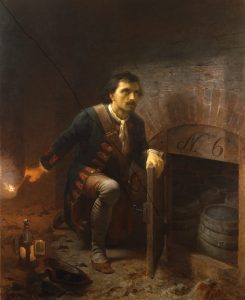
A multi-faceted Turin emerges through the works of art and monuments: a metropolis that was the Savoy capital of princes, generals and soldiers (from Emanuele Filiberto to Carlo Alberto to Pietro Micca); a city of social saints – Giuseppe Cafasso and Giuseppe Benedetto Cottolengo – celebrated in everyday life and monumental rhetoric; the leading city of the Risorgimento, which celebrates the heroes of the wars of independence and the struggle for Italian unification (from the Standard Bearer of the Sardinian Army to Massimo d’Azeglio, and from Garibaldi to Cavour); secular and positivist Turin, keen to commemorate figures from science, civil engagement and business (from Luigi Lagrange to Giuseppe Mazzini and Pietro Paleocapa).
The exhibition brings together around one hundred works – plaster models, bronze sculptures, preparatory drawings, periodicals, photographs and posters illustrating the work of the artists involved in the production of monuments for the city: first and foremost, Carlo Marochetti and Pelagio Palagi, favourites of King Carlo Alberto and exponents of Romanticism, who were succeeded after 1850 by Vincenzo Vela from Ticino, who, with his teaching at the Accademia Albertina, was able to impose his own realist vision, transforming the way monumental sculpture was conceived. Following in his footsteps were Giovanni Albertoni, Odoardo Tabacchi, Giuseppe Cassano, Giuseppe Dini and Alfonso Balzico, creators of some of Turin’s most significant monuments. At the end of the century, the advent of Art Nouveau and neo-Romantic influences can be seen in the work of Davide Calandra, while Pietro Canonica, Edoardo Rubino, Arturo Martini and Eugenio Baroni were the leading figures of the first thirty years of the twentieth century, marked by the First World War and the advent of Fascism.